
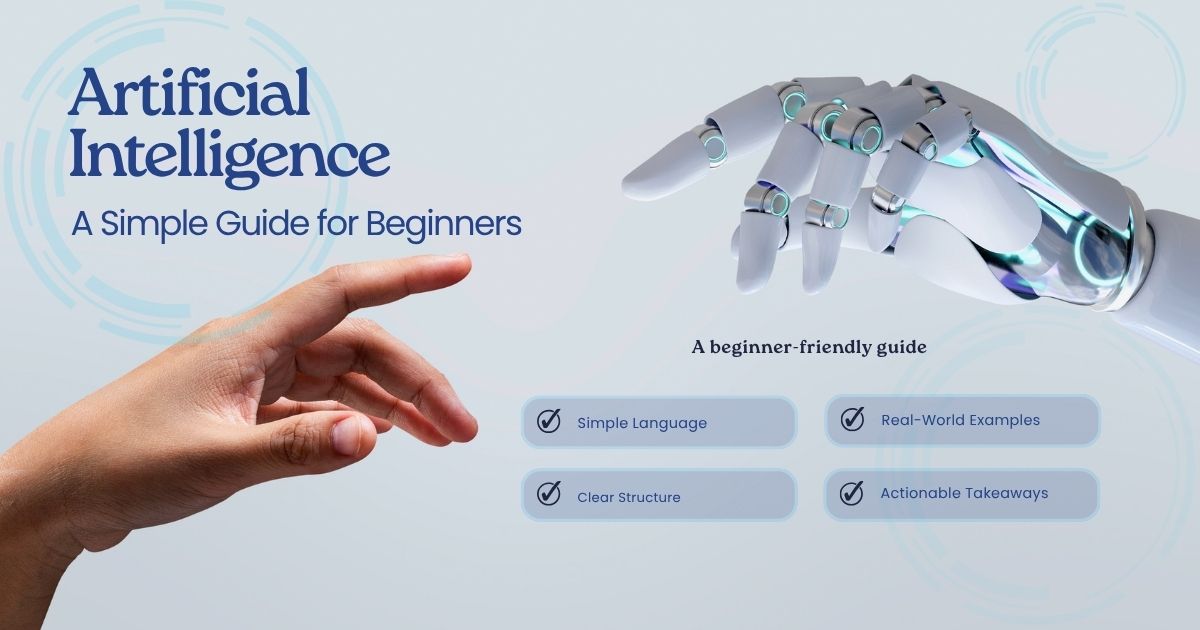
What Is Artificial Intelligence? A Simple Guide for Beginners
Subtitle: No PhD required. Just a simple explanation of the tech that's changing the world.
Introduction: The "Robot" in Your Pocket
If you have ever asked Siri for the weather, let Netflix recommend a movie, or had your email provider sort spam into a separate folder, you have used Artificial Intelligence (AI).
Despite what you see in sci-fi movies, AI isn't about evil robots taking over the world. In fact, AI is already here, and it's quietly making our lives easier.
In this guide, we are going to strip away the hype and the fear. We'll explain what AI actually is, how it works (in plain English), and why it matters to you.
What is Artificial Intelligence, really?
At its simplest, Artificial Intelligence is the ability of a computer to think and learn like a human. It is the science of making machines "smart."
Think of it this way:
- Natural Intelligence = What you and I have. We learn from experience.
- Artificial Intelligence = What a computer has when we program it to learn from data.
Instead of telling a computer exactly what to do step-by-step (like a recipe), we give it a massive amount of information and let it figure out the patterns on its own.
A Quick Metaphor:
Imagine you are teaching a child what a "dog" is.
- Traditional Programming: You write a list: "Dogs have four legs, fur, and a tail."
- Artificial Intelligence: You show the child 1,000 pictures of dogs and 1,000 pictures of cats. The child looks at all the pictures, notices the patterns, and eventually, they just know what a dog looks like—even if you show them a breed they have never seen before.
The "Big Three" Terms: AI, Machine Learning, and Deep Learning
You will hear these three terms thrown around a lot. They are related, but they are not the same thing. Think of them as nesting dolls.
- Artificial Intelligence (AI): The Big Umbrella. The goal of creating smart machines.
- Machine Learning (ML): A way to achieve AI. Instead of programming rules, the machine learns from data.
- Deep Learning (DL): A way to do Machine Learning. It uses something called "neural networks" (loosely inspired by the human brain) to process information. This is the tech behind self-driving cars and voice assistants.
How Does AI Actually "Think"? (The Simple Version)
AI doesn't think like you do. It doesn't have emotions or consciousness. Instead, it relies on three main things:
- Data: AI needs fuel. The more data it has (text, images, numbers), the better it gets.
- Algorithms: This is a fancy word for a set of rules or instructions that tell the computer how to analyze the data.
- Training: This is where the magic happens. You feed the data to the algorithm. It makes a guess. You tell it if it was wrong or right. It adjusts its "rules" slightly. You do this millions of times until it gets accurate.
The Two Main Types of AI (What you will actually see)
To keep things simple, there are two categories of AI you need to know about right now:
1. Narrow AI (Weak AI): The AI That Exists Today
This type of AI is designed to do one specific job exceptionally well.
- Examples: Spotify's song recommendations, Grammarly checking your grammar, or Google Maps finding the fastest route.
- Key point: It does not have consciousness. It doesn't "know" it's recommending a song; it just knows that based on your history, you like this beat.
2. General AI (Strong AI): The AI of the Future
This is the stuff of movies. This would be a machine that has human-level intelligence and can perform any intellectual task that a human can.
- Examples: C-3PO from Star Wars or Data from Star Trek.
- Key point: We have not achieved this yet. We are still decades away from true General AI.
Real-Life Examples You Use Every Day
AI is not a far-off future. It is in your daily routine:
- Navigation: GPS apps use AI to analyze traffic speeds and reroute you.
- Social Media: Instagram and TikTok use AI to decide which videos show up on your feed to keep you scrolling.
- Banking: Banks use AI to monitor for fraud. If your card is suddenly used in another country, AI flags it because it deviates from your "pattern."
- Smartphones: Your phone's camera uses AI to recognize faces and enhance the lighting.
Myth-Busting: What AI is NOT
To understand AI, we need to clear up some common fears:
- Myth: AI will replace all human jobs.
Fact: AI will automate specific tasks (like data entry), but it will also create new jobs. It's better to think of AI as a "co-pilot" rather than a replacement. - Myth: AI is conscious and will develop evil intentions.
Fact: AI is a calculator—a very advanced one. It can solve problems, but it doesn't have feelings, jealousy, or a desire for power. - Myth: You need to be a programmer to understand it.
Fact: You don't need to know how a combustion engine works to drive a car. You don't need to know how to code to use AI.
The Limitations (Because AI isn't perfect)
While AI is powerful, it has flaws:
- Bias: If the data used to train the AI contains human bias (e.g., racial or gender bias), the AI will make biased decisions.
- Lack of Common Sense: AI doesn't "understand" the world. It can write a beautiful poem but doesn't know what love feels like.
- Data Hungry: AI requires massive amounts of data to learn effectively, which can be expensive and raise privacy concerns.
Conclusion: The Future is Collaborating
Artificial Intelligence is arguably the most important technology of our time, but it doesn't have to be intimidating.
AI is a tool. Just like the internet or the smartphone, it is here to amplify what humans are capable of. The best results come when humans and AI work together—human creativity combined with AI's ability to process massive amounts of data.
So, the next time you ask Alexa to set a timer or check a spam folder, remember: you are interacting with the most cutting-edge technology in history... and you're doing it effortlessly.
Your Homework: Next time you use your phone, try to spot which apps are using AI. Is it predicting what you'll type? Is it recognizing your face? The more you look, the more you will find it.